
Legal Text Annotation Services for AI in Law and Compliance

The legal industry generates massive volumes of complex textual data, including contracts, court opinions, regulations, legal briefs, and compliance documents. Legal text annotation services transform this intricate information into structured, machine-readable data that powers AI applications in legal research, contract analysis, compliance monitoring, and litigation support. This comprehensive guide explores how specialized text annotation enables legal professionals and organizations to leverage AI for enhanced accuracy, efficiency, and risk management in legal processes.
Why Is Legal Text Annotation Essential for Legal AI Systems?
Legal text annotation is essential for legal AI because it enables accurate interpretation of complex legal terminology, jurisdictional variations, and contextual nuances. It transforms unstructured legal documents into training data that powers AI systems for contract analysis, legal research, compliance monitoring, and case prediction. High-quality annotation ensures legal AI can understand precise legal meanings, identify patterns, and support accurate legal decisions while maintaining compliance with ethical and professional standards.
The legal domain operates with precision-critical information where subtle differences in wording can significantly alter meanings and outcomes. Legal text annotation provides the foundational training data that allows AI systems to comprehend legal jargon, statutory requirements, case law references, and contractual obligations with the accuracy required for legal applications.
According to a report from the McKinsey Global Institute, AI technologies could automate approximately 23% of lawyers' work, particularly in document review and legal research. This transformation depends on high-quality annotated legal text data that trains AI systems to understand legal language, identify relevant precedents, and extract critical information from complex legal documents. Specialized providers like Labellerr offer legal text annotation services that combine domain expertise with precision annotation to meet the rigorous standards required by legal professionals.
What Types of Legal Text Annotation Are Used in Legal AI?
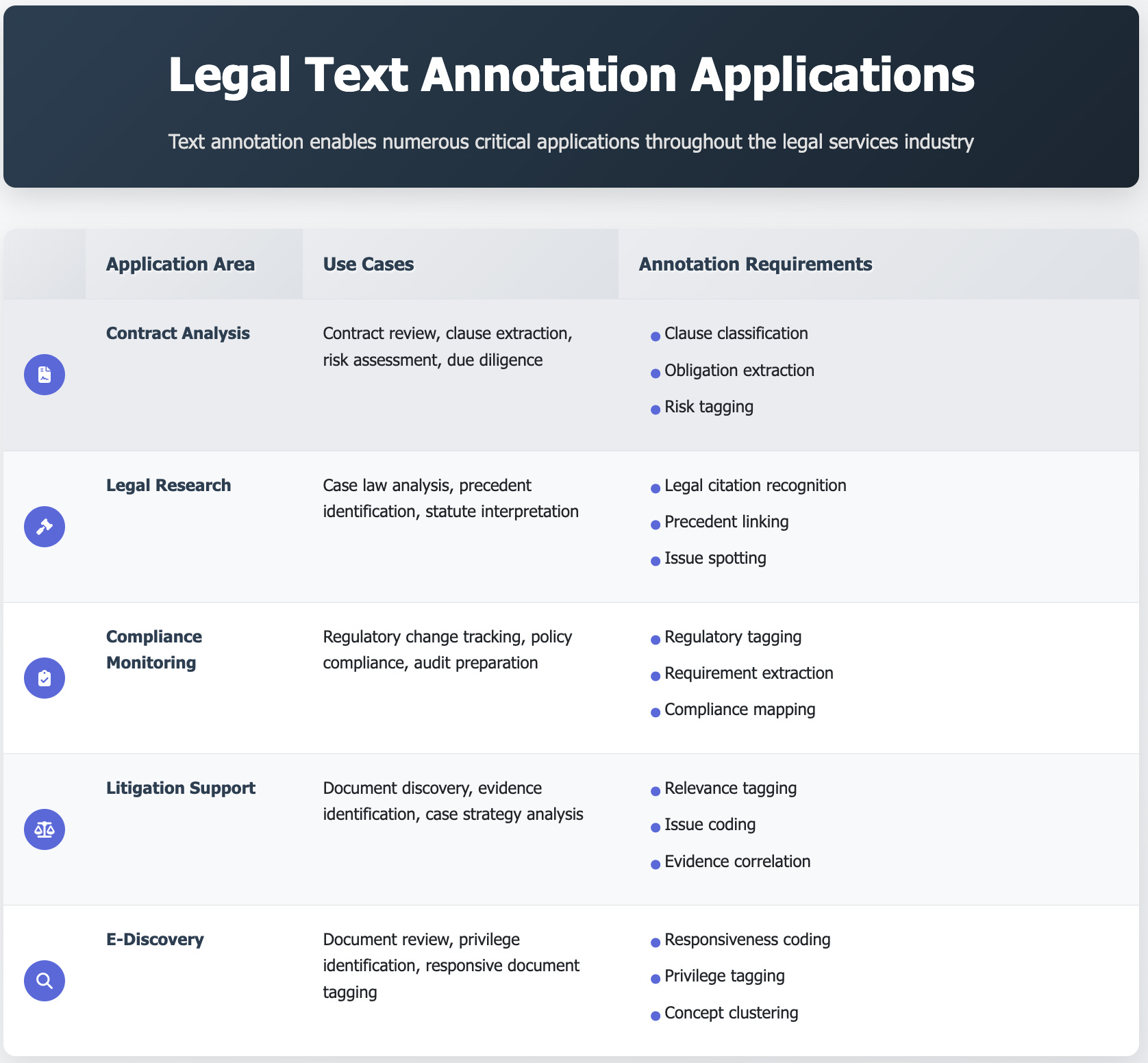
Legal text annotation includes entity recognition for legal terms (parties, jurisdictions, legal concepts), clause classification, obligation extraction, citation analysis, semantic role labeling, relationship extraction between legal entities, and sentiment analysis for judicial opinions. Each type requires specialized legal knowledge and understanding of jurisdictional contexts and legal frameworks.
Legal Entity Recognition
This involves identifying and categorizing legal entities such as party names, jurisdictions, legal citations, statutes, regulations, and specific legal concepts. Accuracy is critical as misidentification can lead to incorrect legal interpretations or compliance issues.
Contract Clause Annotation
Annotation of contract provisions to classify clause types (indemnification, termination, confidentiality), identify obligations and rights, extract key terms and conditions, and flag unusual or risky provisions for legal review.
Regulatory Compliance Annotation
Tagging regulatory documents, compliance requirements, and legal texts to help AI systems understand and monitor regulatory obligations, detect compliance issues, and ensure adherence to legal requirements across different jurisdictions.
Ethical Considerations in Legal Text Annotation
Legal text annotation must adhere to strict ethical and professional requirements:
Confidentiality: Maintenance of attorney-client privilege and client confidentiality
Accuracy Standards: High precision requirements due to legal consequences of errors
Jurisdictional Awareness: Understanding of different legal systems and requirements
Bias Mitigation: Ensuring annotations don't introduce discriminatory patterns
Professional Responsibility: Adherence to legal ethics rules and professional standards
Challenges in Legal Text Annotation
Legal text annotation presents unique challenges that require specialized solutions:
Terminology Complexity: Legal language contains specialized jargon, Latin terms, and context-dependent meanings.
Solution: Employ annotators with legal backgrounds and develop comprehensive legal dictionaries.Jurisdictional Variability: Legal concepts and requirements differ across jurisdictions and change frequently.
Solution: Regular updates to annotation guidelines and ongoing legal monitoring.Document Complexity: Legal documents often contain complex structures, cross-references, and defined terms.
Solution: Hierarchical annotation approaches and context-aware annotation protocols.Precision Requirements: Legal applications cannot tolerate significant error rates due to potential consequences.
Solution: Multi-stage quality assurance, legal expert review, and continuous validation.Confidentiality Concerns: Legal documents often contain sensitive and privileged information.
Solution: Robust data protection measures, anonymization protocols, and secure annotation environments.
Case Study: Enhancing Contract Review with Specialized Legal Annotation
A major law firm partnered with Labellerr to improve their contract review process. Through specialized legal text annotation focusing on contract provisions and risk terms, they achieved:
65% reduction in contract review time
48% improvement in risk clause identification
92% accuracy in obligation extraction
78% faster due diligence processing
Consistent identification of unusual contract provisions across jurisdictions
This demonstrates how specialized text annotation service can significantly enhance legal operations while maintaining accuracy and confidentiality standards.
Best Practices for Legal Text Annotation Projects
Implementing successful legal text annotation requires adherence to specialized best practices:
Legal Expertise Integration: Involve legal professionals (attorneys, paralegals, compliance officers) in guideline development and quality assurance.
Jurisdictional Awareness: Develop annotation protocols that account for differences in legal systems and requirements.
Multi-Tier Quality Assurance: Implement expert-reviewed gold standards, continuous annotator training, and regular accuracy audits.
Confidentiality Protocols: Establish comprehensive security measures for handling sensitive legal information.
Contextual Understanding: Create annotation guidelines that account for legal context and domain-specific nuances.
Continuous Updates: Regularly update annotation protocols to reflect legal changes and new precedents.
How to Choose a Legal Text Annotation Service Provider
Selecting the right partner for legal text annotation requires careful evaluation of specific capabilities:
Legal Domain Expertise: Verify the provider's experience with legal terminology, concepts, and practices.
Confidentiality Track Record: Assess their experience with legal data security and confidentiality requirements.
Quality Assurance Processes: Evaluate their accuracy metrics, validation procedures, and legal expert involvement.
Jurisdictional Knowledge: Determine their understanding of different legal systems and requirements.
Security Certifications: Check for relevant security certifications and data protection capabilities.
References and Case Studies: Review their track record with legal organizations and similar projects.
Companies like Labellerr have developed specialized legal annotation practices that combine legal expertise with technological capabilities to deliver the high-quality labeled data required for legal AI applications.
The Future of Legal Text Annotation
Legal text annotation is evolving to meet the increasing demands of legal AI:
Cross-Jurisdictional Analysis: Development of annotation systems that handle multiple legal systems and languages.
Predictive Legal Analytics: Advanced annotation for predicting case outcomes and legal strategies.
Smart Contract Annotation: Specialized annotation for blockchain-based legal agreements and smart contracts.
Regulatory Change Adaptation: AI systems that automatically adapt to new laws and regulations.
Multimodal Legal Analysis: Integration of text with other data types for comprehensive legal understanding.
Ethical AI Integration: Annotation approaches that incorporate legal ethics and professional responsibility considerations.
Ready to Transform Your Legal Operations with AI-Powered Text Analysis?
High-quality legal text annotation is the foundation of accurate, efficient, and effective AI systems in legal services. Partner with experts who understand both legal terminology and AI data requirements.
Discover how Labellerr's specialized text annotation service for legal applications can enhance your contract review, improve compliance, and streamline legal research while maintaining confidentiality and accuracy standards.
Related Resources
Expand your knowledge with these additional resources on legal text annotation and AI in law:
ABA Legal Technology Resources - American Bar Association legal technology research
Legal AI Applications Survey - Comprehensive review of AI in legal practice
AI in Legal Decision Making - Research on AI applications in judicial systems