
How Data Annotation Helps Farmers Grow Better Crops

What is Precision Agriculture and How Does Data Annotation Help?
Precision agriculture uses technology to make farming more accurate and controlled. Data annotation provides the training data that powers these smart farming systems. By labeling images of crops, soil, and pests, farmers can use AI to make better decisions about planting, watering, and harvesting their crops with amazing precision.
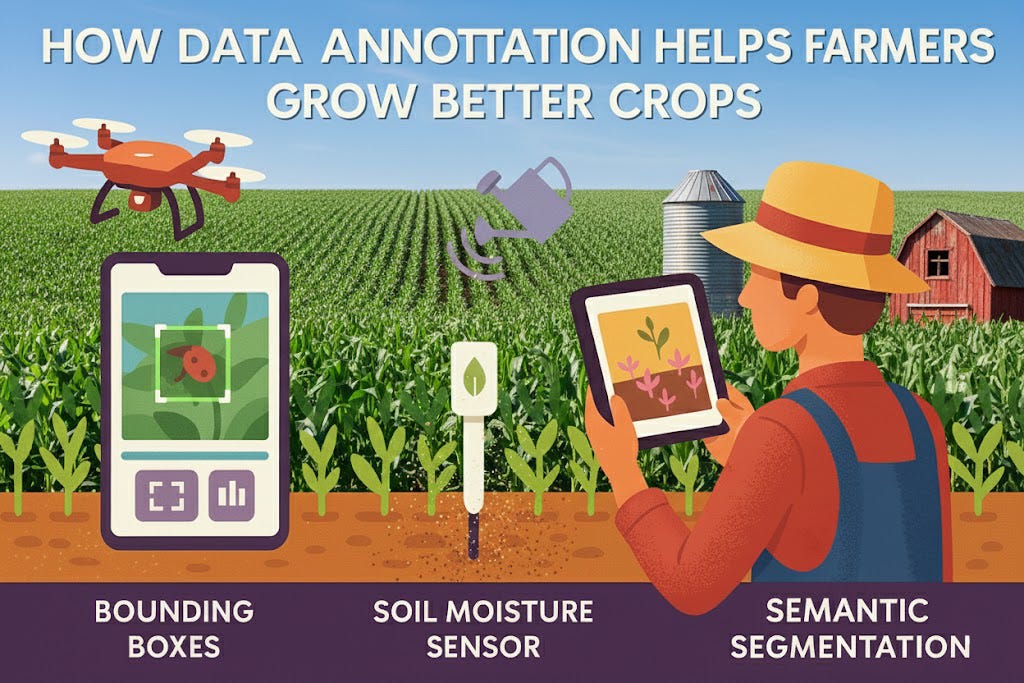
Think of precision agriculture like a doctor giving medicine only where it’s needed instead of treating the whole body. Data annotation helps farming computers see exactly where problems are so farmers can fix only what needs fixing.
How Do Farmers Use Annotated Data in Daily Farming?
Farmers use annotated data through mobile apps and farm management systems that analyze field conditions in real-time. These systems process labeled images from drones and field cameras to provide instant recommendations about irrigation needs, pest control, and harvest timing, making daily farming decisions faster and more accurate than ever before.
Many farmers now use tablets and smartphones to check their fields. The AI systems give them alerts when they find problems. This helps farmers act quickly before small issues become big problems.
Daily Uses of Data Annotation on Farms
Morning field checks using drone images
Soil moisture monitoring through sensor data
Pest detection alerts on mobile devices
Weather-based watering recommendations
Harvest readiness predictions
What Are the Main Data Annotation Methods Used in Farming?
Different farming tasks need different types of data annotation. Here are the most common methods:
Bounding Box Annotation
This is like drawing boxes around objects in pictures. Farmers use this to:
Mark weeds in crop fields
Identify animals in pastures
Locate ripe fruits on trees
Find equipment in farm yards
Semantic Segmentation
This method colors different parts of an image. It helps with:
Separating soil from plants
Identifying different crop types
Mapping field boundaries
Measuring plant coverage
Landmark Annotation
This puts dots on specific points. Farmers use it for:
Marking plant growth points
Tracking animal body features
Identifying fruit stem locations
Mapping leaf vein patterns
Why is Quality Data Annotation Important for Crop Success?
Quality data annotation is crucial because inaccurate labels lead to AI mistakes that can cost farmers significant money and crop losses. Properly annotated data ensures that agricultural AI systems correctly identify problems, recommend appropriate treatments, and help optimize resource use, directly impacting farm profitability and sustainability.
If you teach a computer wrong information, it will make wrong decisions. For example, if weed images are labeled as crops, the AI might tell farmers not to spray weeds. This could let weeds take over a field.
The United States Department of Agriculture emphasizes that accurate agricultural data is essential for food security and sustainable farming practices.
How Does Data Annotation Reduce Farming Costs?
Good data annotation helps farmers save money in several ways:
Reduced Chemical Use
When AI can spot exactly where weeds or pests are, farmers can spray only those areas instead of whole fields. This saves money on chemicals and is better for the environment.
Better Water Management
Annotated soil data helps AI understand where water is needed most. Farmers can water only dry areas instead of entire fields.
Labor Savings
AI can monitor fields 24/7, reducing the need for people to walk through fields checking plants. This saves time and labor costs.
Prevention of Crop Loss
Early detection of diseases through annotated image analysis helps farmers treat problems before they spread, saving entire crops from being lost.
Real Examples of Data Annotation Success in Agriculture
Vineyard Management in California
Wine grape growers use data annotation to monitor grape maturity. Annotators label images of grapes at different ripening stages. The AI then tells farmers exactly when to harvest each section of the vineyard for perfect wine quality.
Rice Farming in Asia
Rice farmers use annotated images to detect bacterial leaf blight early. The International Rice Research Institute has helped develop systems that analyze leaf images and recommend treatments before the disease spreads.
Dairy Farming in Europe
Dairy farmers use annotated images to monitor cow health. AI systems analyze images to detect lameness, body condition, and feeding behavior, helping farmers keep their animals healthy and productive.
What Tools Do Farmers Use for Data Annotation?
Farmers and agricultural companies use various tools for data annotation:
Mobile apps for quick field annotations
Drone software for aerial image analysis
Cloud platforms like Labellerr AI for large datasets
Sensor networks for continuous data collection
Satellite image analysis tools
These tools help make the annotation process faster and more accurate. For example, data annotation for agriculture platforms can process thousands of field images daily, providing farmers with up-to-date information about their crops.
How Can Small Farmers Get Started with Data Annotation?
Starting with data annotation doesn’t have to be complicated or expensive:
Begin with smartphone photos of your crops
Use free annotation apps to label obvious problems
Focus on one crop or one problem at a time
Compare AI recommendations with your own experience
Gradually expand to more advanced tools
The Cooperative Extension System offers resources and training for farmers interested in adopting precision agriculture technologies, including data annotation basics.
Frequently Asked Questions
Do farmers need technical skills to use data annotation?
No, modern agricultural tools are designed to be farmer-friendly. Many use simple mobile apps with easy-to-understand interfaces. Most farmers learn the basics quickly and can start benefiting from the technology within days.
How much does agricultural data annotation cost?
Costs vary widely depending on farm size and needs. Small farms can start with free mobile apps, while large operations might invest in comprehensive systems. The key is that the technology usually pays for itself through better yields and reduced costs.
Is data annotation only for large corporate farms?
No, data annotation technology is becoming increasingly accessible to farms of all sizes. Many service providers offer scalable solutions that work for small family farms as well as large agricultural enterprises.
Ready to improve your farming with smart data annotation? Learn more about data annotation tools for precision agriculture and discover how Labellerr AI can help you grow better crops with less waste.